
116 lines
4.4 KiB
Markdown
116 lines
4.4 KiB
Markdown
# go-fuzzyfinder
|
|
|
|
[](https://pkg.go.dev/github.com/ktr0731/go-fuzzyfinder)
|
|
[](https://github.com/ktr0731/go-fuzzyfinder/actions)
|
|
[](https://codecov.io/gh/ktr0731/go-fuzzyfinder)
|
|
|
|
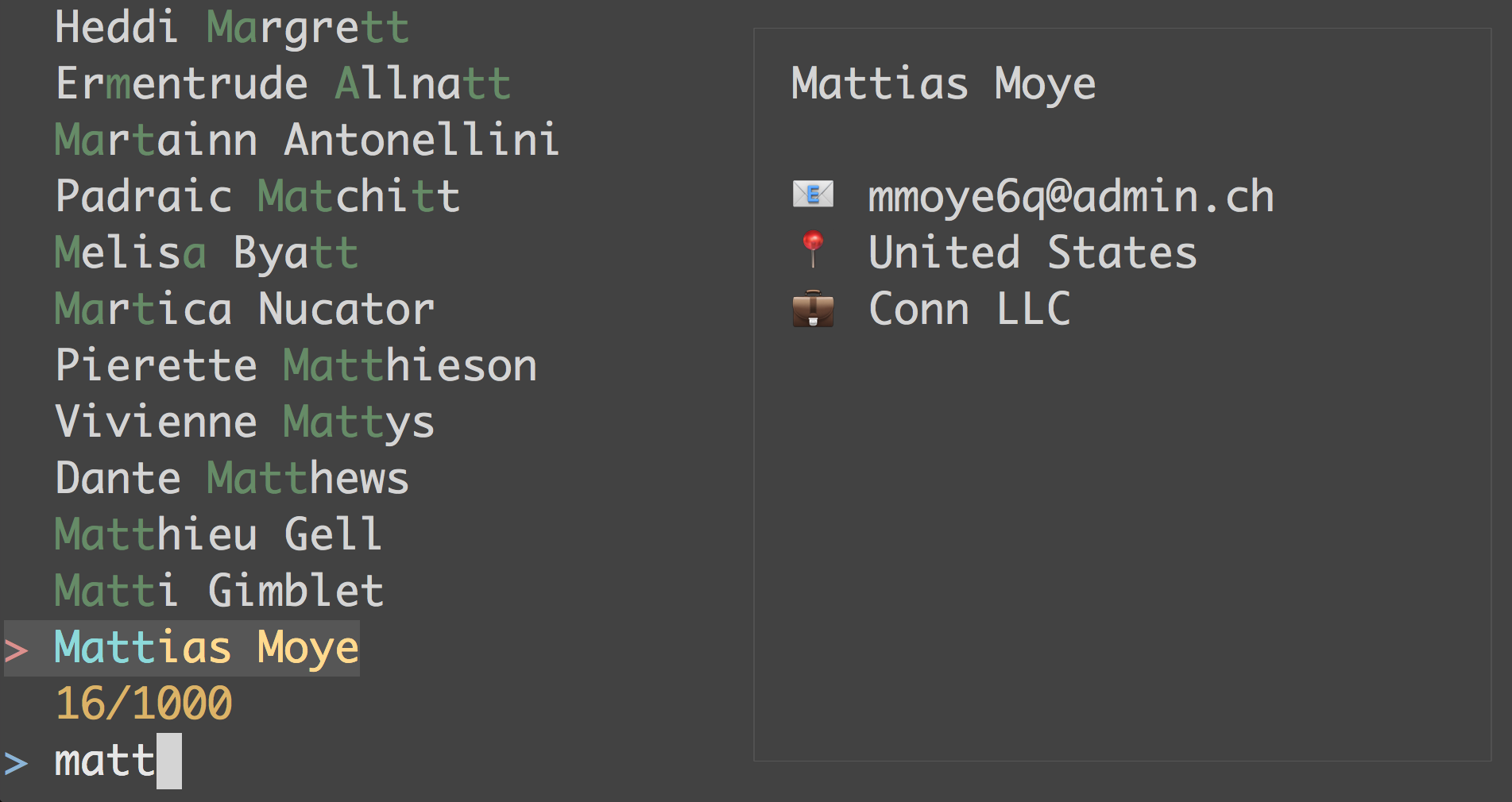
`go-fuzzyfinder` is a Go library that provides fuzzy-finding with an fzf-like terminal user interface.
|
|
|
|
|
|
|
|
## Installation
|
|
``` bash
|
|
$ go get github.com/ktr0731/go-fuzzyfinder
|
|
```
|
|
|
|
## Usage
|
|
`go-fuzzyfinder` provides two functions, `Find` and `FindMulti`.
|
|
`FindMulti` can select multiple lines. It is similar to `fzf -m`.
|
|
|
|
This is [an example](//github.com/ktr0731/go-fuzzyfinder/blob/master/example/track/main.go) of `FindMulti`.
|
|
|
|
``` go
|
|
type Track struct {
|
|
Name string
|
|
AlbumName string
|
|
Artist string
|
|
}
|
|
|
|
var tracks = []Track{
|
|
{"foo", "album1", "artist1"},
|
|
{"bar", "album1", "artist1"},
|
|
{"foo", "album2", "artist1"},
|
|
{"baz", "album2", "artist2"},
|
|
{"baz", "album3", "artist2"},
|
|
}
|
|
|
|
func main() {
|
|
idx, err := fuzzyfinder.FindMulti(
|
|
tracks,
|
|
func(i int) string {
|
|
return tracks[i].Name
|
|
},
|
|
fuzzyfinder.WithPreviewWindow(func(i, w, h int) string {
|
|
if i == -1 {
|
|
return ""
|
|
}
|
|
return fmt.Sprintf("Track: %s (%s)\nAlbum: %s",
|
|
tracks[i].Name,
|
|
tracks[i].Artist,
|
|
tracks[i].AlbumName)
|
|
}))
|
|
if err != nil {
|
|
log.Fatal(err)
|
|
}
|
|
fmt.Printf("selected: %v\n", idx)
|
|
}
|
|
```
|
|
|
|
The execution result prints selected item's indexes.
|
|
|
|
### Preselecting items
|
|
|
|
You can preselect items using the `WithPreselected` option. It works in both `Find` and `FindMulti`.
|
|
|
|
``` go
|
|
// Single selection mode
|
|
// The cursor will be positioned on the first item that matches the predicate
|
|
idx, err := fuzzyfinder.Find(
|
|
tracks,
|
|
func(i int) string {
|
|
return tracks[i].Name
|
|
},
|
|
fuzzyfinder.WithPreselected(func(i int) bool {
|
|
return tracks[i].Name == "bar"
|
|
}),
|
|
)
|
|
|
|
// Multi selection mode
|
|
// All items that match the predicate will be selected initially
|
|
idxs, err := fuzzyfinder.FindMulti(
|
|
tracks,
|
|
func(i int) string {
|
|
return tracks[i].Name
|
|
},
|
|
fuzzyfinder.WithPreselected(func(i int) bool {
|
|
return tracks[i].Artist == "artist2"
|
|
}),
|
|
)
|
|
```
|
|
|
|
## Motivation
|
|
Fuzzy-finder command-line tools such that
|
|
[fzf](https://github.com/junegunn/fzf), [fzy](https://github.com/jhawthorn/fzy), or [skim](https://github.com/lotabout/skim)
|
|
are very powerful to find out specified lines interactively.
|
|
However, there are limits to deal with fuzzy-finder's features in several cases.
|
|
|
|
First, it is hard to distinguish between two or more entities that have the same text.
|
|
In the example of ktr0731/itunes-cli, it is possible to conflict tracks such that same track names, but different artists.
|
|
To avoid such conflicts, we have to display the artist names with each track name.
|
|
It seems like the problem has been solved, but it still has the problem.
|
|
It is possible to conflict in case of same track names, same artists, but other albums, which each track belongs to.
|
|
This problem is difficult to solve because pipes and filters are row-based mechanisms, there are no ways to hold references that point list entities.
|
|
|
|
The second issue occurs in the case of incorporating a fuzzy-finder as one of the main features in a command-line tool such that [enhancd](https://github.com/b4b4r07/enhancd) or [itunes-cli](https://github.com/ktr0731/itunes-cli).
|
|
Usually, these tools require that it has been installed one fuzzy-finder as a precondition.
|
|
In addition, to deal with the fuzzy-finder, an environment variable configuration such that `export TOOL_NAME_FINDER=fzf` is required.
|
|
It is a bother and complicated.
|
|
|
|
`go-fuzzyfinder` resolves above issues.
|
|
Dealing with the first issue, `go-fuzzyfinder` provides the preview-window feature (See an example in [Usage](#usage)).
|
|
Also, by using `go-fuzzyfinder`, built tools don't require any fuzzy-finders.
|
|
|
|
## See Also
|
|
- [Fuzzy-finder as a Go library](https://medium.com/@ktr0731/fuzzy-finder-as-a-go-library-590b7458200f)
|
|
- [(Japanese) fzf ライクな fuzzy-finder を提供する Go ライブラリを書いた](https://syfm.hatenablog.com/entry/2019/02/09/120000)
|